Introducing the Sopranos
Posted: Sun Jan 06, 2013 4:50 pm
Introducing the Sopranos
Introduction
http://meniscusaudio.com/sopranos-pair-p-1369.html
Introducing the Sopranos – they sing in duet (and sometimes with bass accompaniment).
Recently my brother picked up a HT receiver and was in need of some speakers to go with it. I had several sets sitting around, but he felt all of them were too big for what he was looking for, so I suggested that we build what he really wanted. We sat down and worked up exactly what he felt was ideal and then I began to look into potential drivers to use. Mark at Meniscus suggested that I consider the SB Acoustics SB12NRX as a possible driver, and since I have designed four speaker systems using all SB Acoustics drivers I thought a fifth one might be in order, so I decided to give it a try.
http://meniscusaudio.com/sb-sb12nrx254-p-1299.html
For tweeters I went with another SB Acoustics tweeter as well, the SB26STCN-04 which is a small flange 1” dome tweeter with coated textile dome, short waveguide, damped chamber, and a neo magnet. It turned out to be a very nice tweeter for the money. It works very well for systems with small baffles, tight driver spacing, and even low crossover points.
http://meniscusaudio.com/sb-sb26stcn4-p-1206.html
I have designed and built a lot of speakers over the years. In the early days this was done without any serious measurement equipment and with novice working knowledge of speaker design. Still, many of these speakers turned out sounding quite nice. However, there were always some that disappointed me because I never could seem to get them to sound as pleasing as I had expected. Looking back, I was probably dealing with frequency response anomalies that I was not able to tame due to my lack of measurement ability and design knowledge.
As time went by my knowledge of speaker design grew, and with that growth came measurement systems and computer modeling techniques, and designs that were quite refined. It became rare for speakers to not meet my expectations when they were completed, at least from a technical point of view. Sometimes though, their overall sound, imaging, dynamics, etc. would leave me feeling a bit unimpressed. Most of the speakers met my full expectations though, and turned out quite nice, and I was happy to put my name on them. And, every now and then, a design would surprise me and the speaker would come together in a way that would exceed my expectations and leave me quite impressed with what it was able to deliver. This was the case with the “Continuums”, whose vocal resolution was something I had not fully expected, even though that was goal. It is also the case with my “Kairos” Satori two-ways that sound so balanced and resolving that I will probably never give my pair up.
Why do I bring all of this up? Because, the little Sopranos are another one of those speakers that came together to not only meet, but exceed my expectations. I designed them for a certain level of flexibility in placement based on my brother’s application, and that goal was a tremendous success, as these speakers are well balanced whether sitting on a stand away from the walls to siting on a desktop. Sure, the sound is different in both positions, but there are no serious deficiencies either way and you quickly adjust to their balance in either position – especially if you are using a subwoofer when you have them sitting on stands. Listening to the little Sopranos on a nice tall set of stands with subs dialed-in convinced me that I could live with these speakers indefinitely and would have very few regrets.
It is because of their small size, low build cost, high quality of their reproduced sound, and versatility of placement and use, that I have decided to post the full design here and give others an opportunity to build a set if a speaker like this will meet their needs. I know some of you guys are true craftsmen and artists with wood and I would love to see what you come up with and hopefully, I will get to hear another set or two at some upcoming DIY gathering and happily chat with the builders.
The Cabinet and Low Frequency Design
My brother decided on a cabinet that is relatively small. It even looks small sitting next to my Continuums, which are generally a tiny speaker. Sure, there are some mass produced plastic speakers that are smaller than these, but the Sopranos aren’t that kind of speaker….
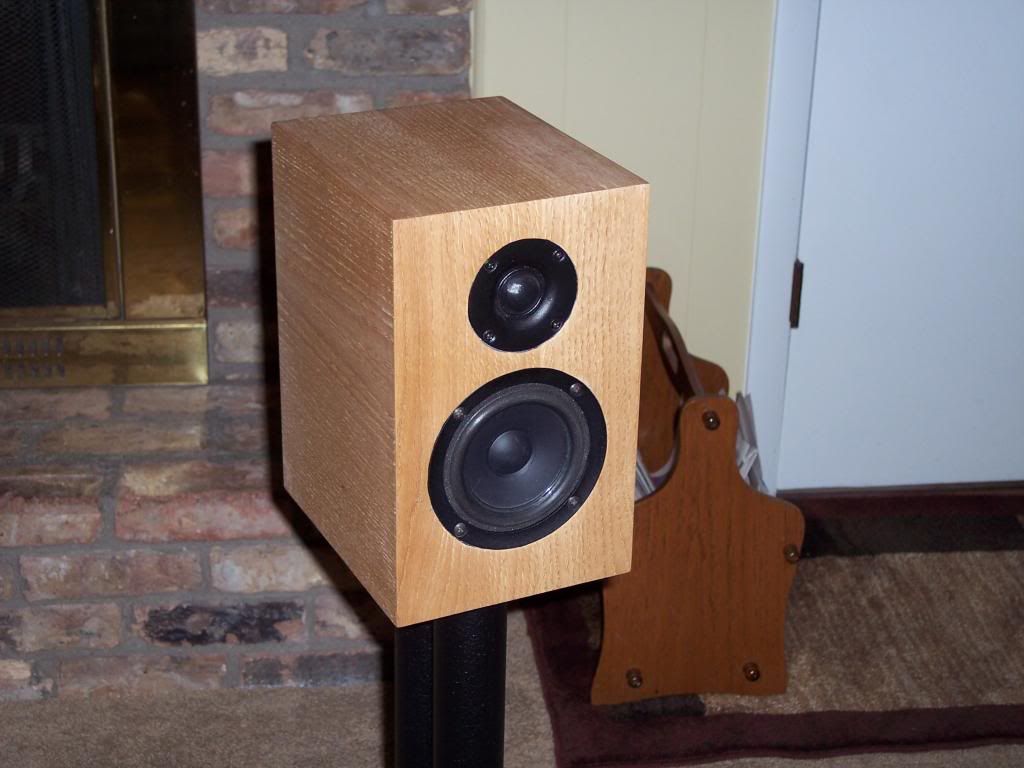
The cabinet measures 6.5” wide by 10.5” tall by 8” deep. It is made of ¾” MDF with an internal brace. The final volume is 4.7 liters or .17 cubic feet. Both drivers are centered horizontally on the baffle with a space of 3.8” between them. My brother decided to finish his cabinets using a flat black Rustoleum truck bed-liner which matches the color of the drivers so well that finished pics are hard to see well, so I will include some pics before the cabinets were painted for clearer presentation.
These speakers are ported on the back. I used a standard 1.25” diameter adjustable port that Meniscus sell. To make it even easier, I used only the inside section with the mounting flange. This leaves the port a little over 4” long and tunes this enclosure to 61Hz. However, since this port is adjustable I will give you some options. Here’s a pic of the front and back of the finished painted enclosure.
Part two has measurements and crossover details.....
Introduction
http://meniscusaudio.com/sopranos-pair-p-1369.html
Introducing the Sopranos – they sing in duet (and sometimes with bass accompaniment).
- sb12nrx25-04.jpg (16.45 KiB) Viewed 54162 times
http://meniscusaudio.com/sb-sb12nrx254-p-1299.html
For tweeters I went with another SB Acoustics tweeter as well, the SB26STCN-04 which is a small flange 1” dome tweeter with coated textile dome, short waveguide, damped chamber, and a neo magnet. It turned out to be a very nice tweeter for the money. It works very well for systems with small baffles, tight driver spacing, and even low crossover points.
- SB26STCN-C000-4.jpg (50.8 KiB) Viewed 54162 times
http://meniscusaudio.com/sb-sb26stcn4-p-1206.html
I have designed and built a lot of speakers over the years. In the early days this was done without any serious measurement equipment and with novice working knowledge of speaker design. Still, many of these speakers turned out sounding quite nice. However, there were always some that disappointed me because I never could seem to get them to sound as pleasing as I had expected. Looking back, I was probably dealing with frequency response anomalies that I was not able to tame due to my lack of measurement ability and design knowledge.
As time went by my knowledge of speaker design grew, and with that growth came measurement systems and computer modeling techniques, and designs that were quite refined. It became rare for speakers to not meet my expectations when they were completed, at least from a technical point of view. Sometimes though, their overall sound, imaging, dynamics, etc. would leave me feeling a bit unimpressed. Most of the speakers met my full expectations though, and turned out quite nice, and I was happy to put my name on them. And, every now and then, a design would surprise me and the speaker would come together in a way that would exceed my expectations and leave me quite impressed with what it was able to deliver. This was the case with the “Continuums”, whose vocal resolution was something I had not fully expected, even though that was goal. It is also the case with my “Kairos” Satori two-ways that sound so balanced and resolving that I will probably never give my pair up.
Why do I bring all of this up? Because, the little Sopranos are another one of those speakers that came together to not only meet, but exceed my expectations. I designed them for a certain level of flexibility in placement based on my brother’s application, and that goal was a tremendous success, as these speakers are well balanced whether sitting on a stand away from the walls to siting on a desktop. Sure, the sound is different in both positions, but there are no serious deficiencies either way and you quickly adjust to their balance in either position – especially if you are using a subwoofer when you have them sitting on stands. Listening to the little Sopranos on a nice tall set of stands with subs dialed-in convinced me that I could live with these speakers indefinitely and would have very few regrets.
It is because of their small size, low build cost, high quality of their reproduced sound, and versatility of placement and use, that I have decided to post the full design here and give others an opportunity to build a set if a speaker like this will meet their needs. I know some of you guys are true craftsmen and artists with wood and I would love to see what you come up with and hopefully, I will get to hear another set or two at some upcoming DIY gathering and happily chat with the builders.
The Cabinet and Low Frequency Design
My brother decided on a cabinet that is relatively small. It even looks small sitting next to my Continuums, which are generally a tiny speaker. Sure, there are some mass produced plastic speakers that are smaller than these, but the Sopranos aren’t that kind of speaker….
The cabinet measures 6.5” wide by 10.5” tall by 8” deep. It is made of ¾” MDF with an internal brace. The final volume is 4.7 liters or .17 cubic feet. Both drivers are centered horizontally on the baffle with a space of 3.8” between them. My brother decided to finish his cabinets using a flat black Rustoleum truck bed-liner which matches the color of the drivers so well that finished pics are hard to see well, so I will include some pics before the cabinets were painted for clearer presentation.